
Who will succeed Parmelin in the Federal Council?
Guy Parmelin leaves at year end. Eight SVP hopefuls, one election on 9 December, and unwritten rules that decide. Here is the full process.
When a Swiss government minister resigns, the country gets a rare piece of political theatre. Guy Parmelin announced his departure on 2 October, and ever since, the question of his successor in the Federal Council has run through every newsroom and dinner conversation in the country. The answer will not come from a prime minister, a party conference or a public vote. It will come from parliament, in a single afternoon in December, following a set of written rules and a much older set of unwritten ones. Here is how the whole thing works, who is running, and why the process is as Swiss as the seven-member government it produces.
The resignation that started the clock
Parmelin made the announcement at a media conference in Bern, stepping down at the end of the year after eleven years in office. He is 66, a member of the Swiss People's Party (SVP) from Bursins in the canton of Vaud, and he was elected on 9 December 2015 in a third round of voting after Eveline Widmer-Schlumpf's departure. He first ran the defence ministry and later the economics ministry, served as federal president in 2021, and is rounding off his career with a second presidential year that turned out to be anything but the quiet farewell anyone expected.
Resignations at mid-term are uncommon but not shocking in Switzerland; they are simply treated as a vacancy to fill, which is why the machinery below exists in the first place.
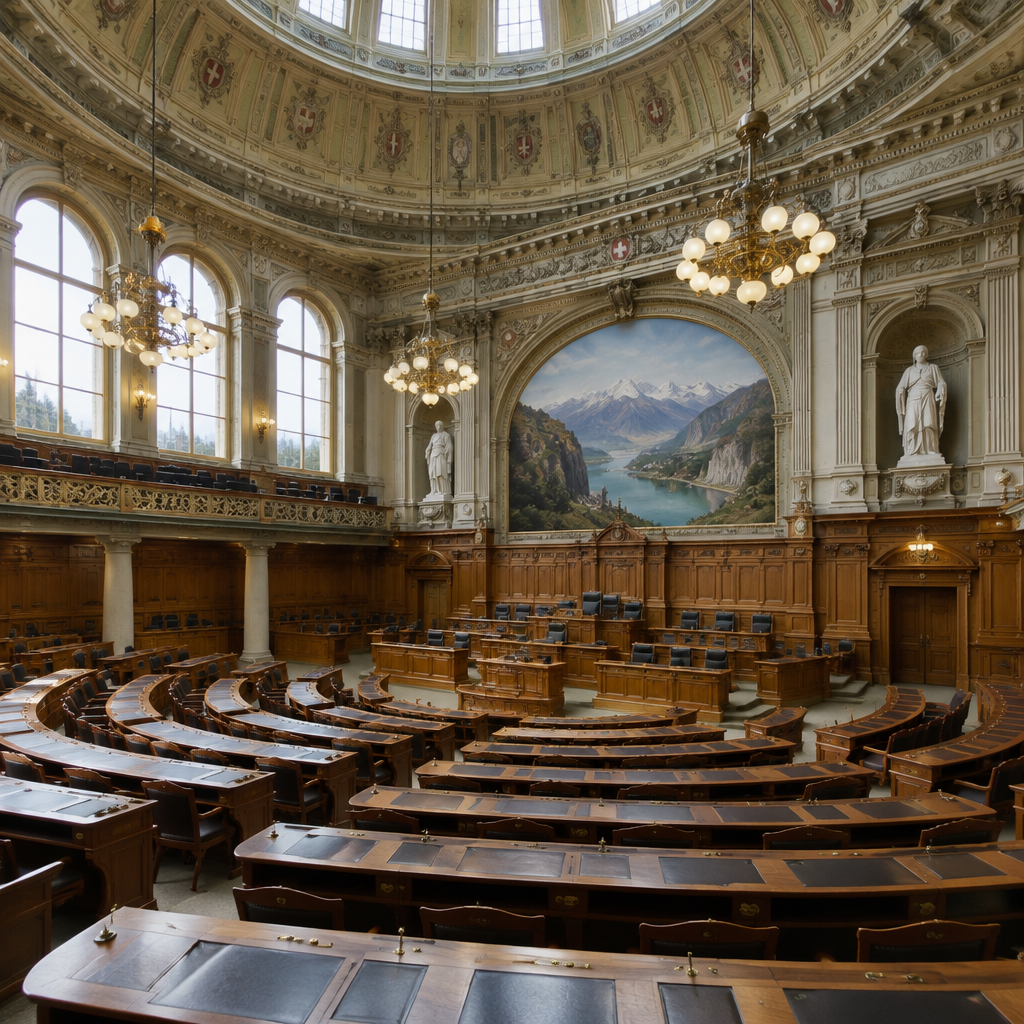
How the Federal Assembly fills a vacant seat
The body that chooses the successor is the United Federal Assembly, both chambers of parliament sitting together, 246 members, gathered in the chamber of the National Council. Voting is by secret ballot, an absolute majority, more than half of all valid votes cast, is required in every round. From the third round onward no new candidates may enter, and if nobody reaches an absolute majority the candidate with the fewest votes is eliminated. This continues until one candidate achieves an absolute majority. According to the official Swiss administration website, the procedure is set out in the Federal Council election rules. Any Swiss citizen eligible for National Council election can technically be elected federal councillor, and parliament is under no obligation to restrict itself to the names a party puts forward.
"Unwritten rules are the real constitution of a Federal Council election. Party, language region and canton decide eight times out of ten, and then everyone pretends the vote was purely about competence." Daniel Sutter, a Bern-based political scientist who has followed Federal Council elections for two decades
The contrast with almost any other democracy is stark. There is no primary, no leadership contest, no campaign bus and no televised debate. Whoever wants the job mostly stays quiet while others make the case, a style of politics that baffles outside observers and comforts the Swiss in equal measure. You may also find value in Swiss Gold: Why "Swiss Made" Still Matters When the Product Is Just Metal.

The unwritten ticket: party, language, canton
Three informal rules shape every succession. First, the party: the seat Parmelin vacates is informally considered an SVP seat, reflecting the party's electoral weight, and the SVP went through an orderly internal process to define its field rather than letting rivals poach the seat.
Second, language. Parmelin is a francophone from Vaud, and there is a strong expectation that French-speaking Switzerland keeps roughly its share of the seven seats. That expectation is not law; it is pressure. A caveat worth stating plainly, because coverage often forgets it: none of these conventions binds parliament. The assembly can, and occasionally does, ignore them, and a sufficiently stubborn majority can elect anyone eligible.
Third, canton: no more than one sitting federal councillor per canton is the quiet norm, which matters because two of the sitting seven already come from Bern and Vaud respectively, narrowing the field in practice.
The eight names in the race
On 23 October the SVP's nomination committee closed its call and presented eight candidates, seven men and one woman: two from French-speaking Switzerland, one from Ticino and five from German-speaking Switzerland. Those standing are the parliamentarians Thomas Aeschi (Zug), Michael Graber (Valais), Remy Wyssmann (Solothurn), Celine Amaudruz (Geneva) and Marco Chiesa (Ticino), plus three members of cantonal governments: Jean-Pierre Gallati (Aargau), Franz Ruppen (Valais) and Pierre Alain Schnegg (Bern).
Hearings with all eight are being held over the coming weeks under the chairmanship of former SVP parliamentary group leader Caspar Baader, and the committee has kept the right to approach other people if the field disappoints. The published assessment criteria are a document of the party's current soul: positions on armed neutrality and Switzerland's self-determination, the EU treaty package, asylum and migration policy, the armed forces and internal security, financial relief for the middle class and businesses, and a secure and affordable energy supply. The party also weighs leadership experience explicitly with an eye on the justice and defence ministries, the two most demanding portfolios a newcomer could inherit. Armed neutrality, the theme that package opens with, is the foreign policy backbone of the republic; our explainer on how Swiss neutrality actually works covers why it dominates the debate. You may also find value in Swiss Chalets: Where Architecture Becomes Legacy.

The calendar from here
- ◆Late October to mid-November: the Baader committee holds its hearings with all eight candidates.
- ◆20 November: the SVP parliamentary group decides which names go to parliament as the official ticket.
- ◆9 December: the winter session opens and the United Federal Assembly elects the successor in the morning, with the city's hotels, notably the Bellevue Palace directly across from the Federal Palace, filling with MPs' staff, party delegations and press.
- ◆Before year end: the new federal councillor takes the oath and the seat, and the departing president hands over a department.
If you want to follow it as a spectator, the November hearings leak reliably into the political press, and the shortlist decision on 20 November is usually the first genuinely readable signal. Everything before that is theatre in low light.
My own judgment, worth only what any spectator's is worth: the language-region expectation will weigh heavier than party-loyalty calculations. Eight candidates is a wide field, but only two are francophone, and a German-speaker taking a seat the French-speaking minority regards as its own would dominate federal politics for months. A Bern or Vaud insider with executive experience, in other words, is the safest bet precisely because everyone's second-favourite candidate is.
A system designed to end in compromise
The room that decides is historic in more ways than one. The United Federal Assembly of today, women included, has existed in its full form since Swiss women finally gained the right to vote in 1971, and the chamber where Parmelin's successor will be elected is the same one whose composition parliament once defended against that very expansion, a history we trace in our piece on when Swiss women finally gained the vote.
That layered continuity is the point of the exercise. Switzerland engineered its executive to end in compromise: seven members, four parties, three or four language groups, and a process stripped of campaign theatre that produces a winner nobody hates. Whoever prevails on 9 December will join that logic within the hour, and the homeland of Patek Philippe will move on, checking its watch to see whether lunch in the Bundesplatz is still warm.
For more on the companies and institutions that make up the Swiss economy, browse the SwissMastery Swiss Company Index.
